

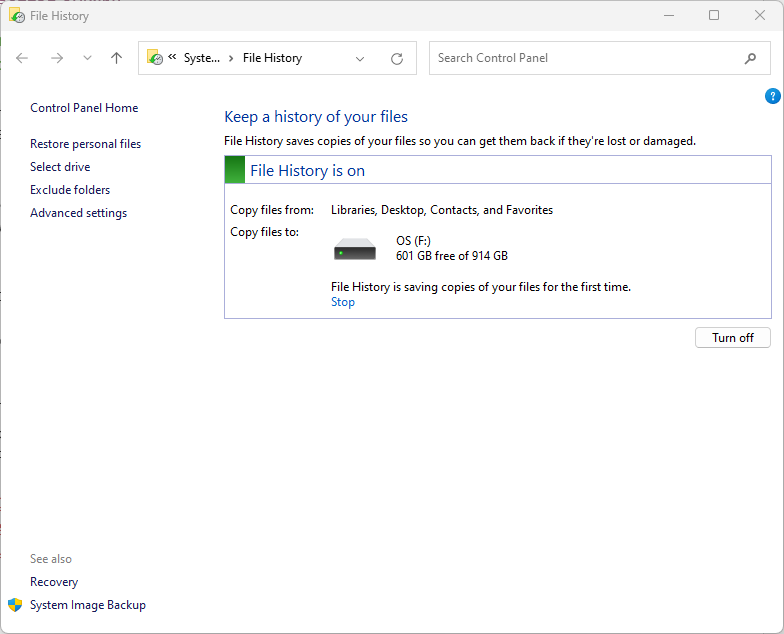
Using File History from Control Panel in Windows 11.
Preston Gralla / Foundry
To exclude folders from the backup, select Exclude folders from the left navigation menu, click Add, and choose the folders you want to exclude.
To copy the backed-up files to your new PC, plug the drive into it, repeat the above steps, and click Restore personal files.
For more detailed instructions, see “How to use File History in Windows 10 and 11.”
Transfer files via an external drive
To migrate files and folders to your new PC, you can dispense with using any special software at all, and instead connect an external hard drive, SD card, or thumb drive to your old PC, copy your files to it, then eject that device from the old computer, plug it into the new PC and copy the files to that new PC. The trick here (besides having enough storage capacity on your transfer drive) is to have your files and folders organized well enough so you get them all.
We recommend that you use the same folder organization on your new PC as on your old computer, at least to start.
Note: If you are transferring files from a Mac to a PC, the external hard drive must be formatted as MS-DOS, not NTFS or APFS. SD cards and thumb drives use the same FAT32 format on both macOS and Windows, so if your files fit on those storage devices, that’s often easier than using a hard drive.
| A note about transferring email
If you use a cloud-based mail service such as Gmail or the Outlook web app, you don’t need to transfer your mail files. However, if you use client-based email software (like the desktop version of Outlook), you’ve got some work ahead of you. Direct file transfer will not move your locally stored email files to the new PC, and copying them to a new PC often doesn’t work because of how they are tied to the email application’s OS settings. We recommend you make sure all your emails are stored in your email server so they can just sync to the email client on your new PC. The Microsoft Outlook client supports several servers, not just Microsoft’s Exchange and Microsoft 365 typically used in business. IT retention policies may limit how far back emails are stored on the server, so you may have local emails you can’t transfer that way. In that case, Microsoft Outlook does let you import the local .PST files to a Windows PC from the Outlook app on another Windows PC or Mac; Microsoft has provided export instructions and separate import instructions. Different client versions of Outlook have different maximum size limits for .PST files that can be transferred from one computer to another. So if you’re planning to move .PST files, read this Microsoft article to find out those limits and get advice on ways you might be able to reduce the size of .PST files before trying to transfer them. Local contacts and calendar entries likewise are very difficult to directly transfer from one computer to another, and it is best to make sure they are stored on a server, such as Exchange, Microsoft 365, Google Workspace/Gmail/Google Calendar, or iCloud, so they will sync to your contacts and calendar apps on your new PC. Your contacts and calendar apps may have an export feature that you can try. (You can often export individual contacts as a VCF file, for example.) These days, few contacts and calendar apps are not server-based, so chances are very high your contacts and calendar entries are stored somewhere they can be synced. |
Transfer files with a USB data-transfer cable
One of the simplest ways to move files from your old PC to a new one is to use a USB data-transfer cable. You can’t use just any USB cable; it needs to be one specially designed to transfer data. When you plug the cables in, they often automatically install the drivers they need. They also come with file-transfer software that tends to be bare-bones but does the trick.
You can easily find the cables online. If you’re transferring files between two PCs that have USB-C ports, check out this PCWorld article with recommendations for the best ones.
Transfer files locally over Wi-Fi or LAN
If you’d like, you can move your files from your old PC to your new PC via Wi-Fi or a LAN. To do it, the PC with your files and the PC to which you want to transfer them need to be on the same Wi-Fi or Ethernet network.
To do it, you need to turn on network discovery and file sharing on both the PCs. In Windows 11, select Settings > Network & Internet > Advanced network settings > Advanced sharing settings, and turn on the toggles for Network Discovery and File and printer sharing.
In Windows 10, select Settings > Network & Internet > Network and Sharing Center. That will launch the Control Panel. In Control Panel, select Change advanced sharing settings from the right side of the screen. On the screen that appears, in the Network Discovery section, select Turn on network discovery, and in the File and Printer sharing section, select Turn on file and printer sharing.
You can now drag and drop files and folders from your old PC to your new one using Windows Explorer. Click Network at the bottom of the left-hand pane in File Explorer, find the new PC to which you want to transfer files and folders, and copy them to it.
Note that transferring files this way can be flaky — you may have problems with your PCs showing up on the network. Setting it up takes only a few minutes, though, and if it doesn’t work you can always use another method in this story to transfer the files. (For troubleshooting help, you may want to use the advice in PCWorld’s article “Windows 11: How to set up a local network.”)
Transfer files, settings, and more via file-transfer software
If you want more hand-holding in your file transfer, you can buy and use a utility like Laplink’s $60 PCmover Professional, which has been around for decades. It works over your network (either Wi-Fi or Ethernet) or via Laplink’s Ethernet or USB cables (these cost extra). It lets you choose which files and folders to transfer, and will transfer your settings, bookmarks, and applications too. You can migrate from old Windows versions to later Windows versions, as well as between the same versions. (One exception: you cannot migrate from Windows XP to Windows XP.)
Note: You need administrator privileges in Windows to use all of PCmover’s capabilities.
Before you transfer any applications via a utility like PCmover, sign out of or deactivate any apps on your old computer. Most software these days is tied to an online account that limits the number of active installations or has digital rights management to prevent piracy via copying. You don’t want the transfer to be seen as a piracy attempt or as an additional installation that counts against any limit you may have.
Another option is EhlerTech’s USMTGUI, a graphical front end to Microsoft’s command-line User State Migration Tool. USMTGUI (like USMT) transfers only settings and associated data like emails, not applications. The home version pricing starts at $10, and the corporate license pricing starts at $300.
Install and set up apps on your new PC
Regardless of the transfer method you use, you almost certainly will have apps to reinstall, depending on what IT did for you in preparing your new computer. (PCmover Professional will transfer most apps; its documentation describes its limitations.)
On your new PC, re-download the apps you need and sign in as required. You’ll find some apps on the Microsoft Store, while others you’ll need to download from the software vendor’s website. As noted earlier, if you restore from a backup in Windows Backup, you’ll find placeholders for your apps that can speed up this process.
In most cases, you’ll need to set up your applications’ preferences on the new computer, so set aside the time to do that.
Transfer browser bookmarks to your new PC
You also will want to transfer your bookmarks from your old computer’s browser to your new computer’s browser. There are three methods: direct syncing between the same browser and exporting a browser’s bookmark files to import into a different browser. The first method keeps the browsers in sync, whereas the second method is a manual approach for when you are moving to a new computer (or browser) and won’t use the old computer (or browser) anymore.
Chrome, Firefox, and Edge all sync bookmarks across all your devices if they are all signed into the same account. Just enable syncing in each browser on each device you use. To be clear, you can sync only to the same browser, such as from Chrome to Chrome.
For situations where your browser is not signed into the same account as your old computer, the major browsers all have a facility to export and import bookmarks via files:
- Google Chrome: To export bookmarks, click the vertical three-dot icon at the top right of your browser window, then select Bookmarks and lists > Bookmark Manager from the menu that appears. Click the three-dot icon to the right of the search bar and select Export bookmarks. To import bookmarks, follow the same procedure but choose Import bookmarks instead of Export Bookmarks.
- Mozilla Firefox: To export bookmarks, click the Menu button (three horizontal lines) on the top right of the screen, then select Bookmarks and click Manage bookmarks at the bottom of the screen. Select Import and Backup from the top of the screen that appears and choose Export Bookmarks to HTML. To import bookmarks, follow the same procedure but choose Import Bookmarks from HTML instead of Export Bookmarks to HTML.
- Microsoft Edge: Click the Favorites button (the star icon), then click the three-button icon at the top of the panel that appears and choose Export favorites. To import bookmarks, follow the same procedure but choose Import favorites instead of Export favorites.
What to do after migrating your files and apps to the new PC
When everything is transferred, be sure to take these steps to protect your data:
- Sign out of all your accounts on the old computer. This includes Microsoft, Google, browser sync, passwords, financial information, cloud storage accounts, and others. You don’t want the next owner to be able to use your accounts, especially any that may connect to credit and debit cards or bank accounts.
- Consider wiping/reformatting the old computer, but check with IT first if it’s a business computer, in case they need to keep it as is for some period of time for regulatory or HR policy reasons. If your own computer and you’re feeling particularly paranoid, you can remove the old hard disk and physically destroy it.
- Back up your new PC. Don’t forget to establish a regular backup routine on your new Windows computer, whether it’s through File History, image backup software, or the new Windows Backup facility in Windows 11.
This article was originally published in November 2020 and most recently updated in December 2025.

