

Mike Woodger: ACE pilot
March 28, 1923 – July 14, 2025
Credit: National Physics Laboratory
While at the United Kingdom’s National Physical Laboratory in the 1940s, Alan Turning designed the ACE (Automatic Computing Engine) computer. When he left in 1947, it fell to Mike Woodger and his team to complete the project, which culminated in a scaled-down prototype in 1950. The Pilot ACE, one of the UK’s first computers, was so practical that a full-fledged ACE was never built; instead, the Pilot ACE was adapted for commercial use under the name DEUCE.
Woodger later contributed to the development of the programming languages ALGOL 60 and Ada. The latter was commissioned by the US Department of Defense to replace over four hundred different programming languages then in use across the DoD; the department still uses Ada today. Woodger was 102.
Margaret Boden: AI philosopher
November 26, 1936 – July 18, 2025
As a philosopher and cognitive scientist, Margaret Boden dedicated her life to studying artificial intelligence. She theorized not only what AI could and could not be capable of (such as various kinds of creativity), but also how it could serve as a model for the human condition and thought processes.
In 2010, Boden contributed to “Principles of Robotics,” an influential paper proposing five rules for responsible robotics development, such as “the illusion of emotions and intent should not be used to exploit vulnerable users” and “robots should be designed and operated to comply with existing law, including privacy.” These standards became the basis for UNESCO’s official recommendations for laws to govern our growing use of AI tools such as large language models — tools that Boden herself predicted but never experienced firsthand, as she was already in a care home by the time LLMs emerged. Boden was 88 when she passed.
Gilles Dowek: Formal unifier
December 20, 1966 – July 21, 2025
Gilles Dowek was a researcher at the National Institute for Research in Digital Science and Technology (Inria), a French computer science and applied mathematics research institute. There, he observed that Inria’s different teams were siloed, using different organizational methods and proof systems to conduct their research. Dowek set out to unify these formal logic systems to improve communication and discoverability between teams. His later work focused on programming languages for quantum computers and logic as a field of thought.
Dowek was also a tireless human rights advocate who chaired the Association for the Recognition of the Rights of Homosexual and Trans People to Immigration and Residence (Ardhis), ensuring that French citizens and nationals, at home or abroad, have the right to residence and asylum. He was 58 when he died.
Morton Meyerson: The outsourcer
June 3, 1938 – August 5, 2025
Credit: Next Jump
H. Ross Perot may have revolutionized IT outsourcing when he founded Electronic Data Systems (EDS), but Morton Meyerson was the brains of the operation. Hired in 1966 as EDS’s 54th employee, Meyerson swiftly secured the company a contract with Blue Cross Blue Shield of Texas. Meyerson used this opportunity to implement a business model that became known as IT outsourcing, leading EDS’s profit to increase a hundredfold in just two years. Meyerson eventually became the president of EDS, remaining in the role even after General Motors bought EDS for $2.5 billion in 1984.
He later founded a family investment firm, 2M Companies, and a philanthropic nonprofit, Morton H. Meyerson Family Foundation. He was inducted into the Outsourcing Hall of Fame in 2013. Meyerson died at age 87.
Stephanie Shirley: Call me Steve
September 16, 1933 – August 9, 2025
Born in Germany to a Jewish family in 1933, Stephanie Shirley escaped to the United Kingdom, where she became a gifted and determined mathematician and computer scientist. After being subjected to the sexism that was rampant in a male-dominated industry, Shirley set out to ensure a different experience for those who followed. She founded Freelance Programmers, an outsourcing company that hired women, especially mothers, almost exclusively. Contracts came more easily when she signed her name “Steve,” and Freelance Programmers eventually grew into Xansa, a multi-billion-dollar company whose projects included the Concorde airplane’s “black box” flight recorder.
Shirley gave away most of her fortune to charities and even to her own employees, making millionaires of countless other women. Shirley was 91.
Warren Brodey: Enhancing AI
January 25, 1924 – August 10, 2025
Credit: Post-Utopia
Trained as a psychiatrist, Warren Brodey nonetheless focused on cybernetics and artificial intelligence throughout his life. Starting in 1965, he spent most of his career at MIT, where he worked alongside famed AI researcher Marvin Minsky. Whereas Minsky advocated for AI based on large quantities of existing data, thus reinforcing existing norms, Brodey campaigned for AI that, by being creative and revolutionary, would rethink and enhance humanity.
Brodey co-founded two labs, the Environmental Ecology Lab and later Ecology Tool and Toy, where he further explored materials and environments that responded to and improved human behavior — concepts he still believed possible, even with the rise of modern AI that followed Minsky’s model. He died at 101.
Vaidyeswaran Rajaraman: India’s grandfather of IT education
September 8, 1933 – November 8, 2025
Credit: DoRA IITK
As a student at the Indian Institute of Science (IIsc) in 1956, Vaidyeswaran Rajaraman was instrumental in designing the Philbrick Rideout Electronic Differential Analyzer (PREDA), India’s first analog computer. He went on to establish the country’s first formal computer science program of study at the Indian Institute of Technology Kanpur (IITK) in 1965. In 1987, he helped the government found the Centre for Development of Advanced Computing, bringing supercomputer development to India.
Over the course of his long career in academia, Rajaraman wrote 23 computer science textbooks on topics ranging from Fortran to ecommerce, informing and influencing generations of computer scientists worldwide. Some of his own students went on to lead Indian IT giants Tata Consultancy Services and Infosys. He was 92 when he passed.
Rebecca Heineman: Burger Becky
October 30, 1963 – November 17, 2025
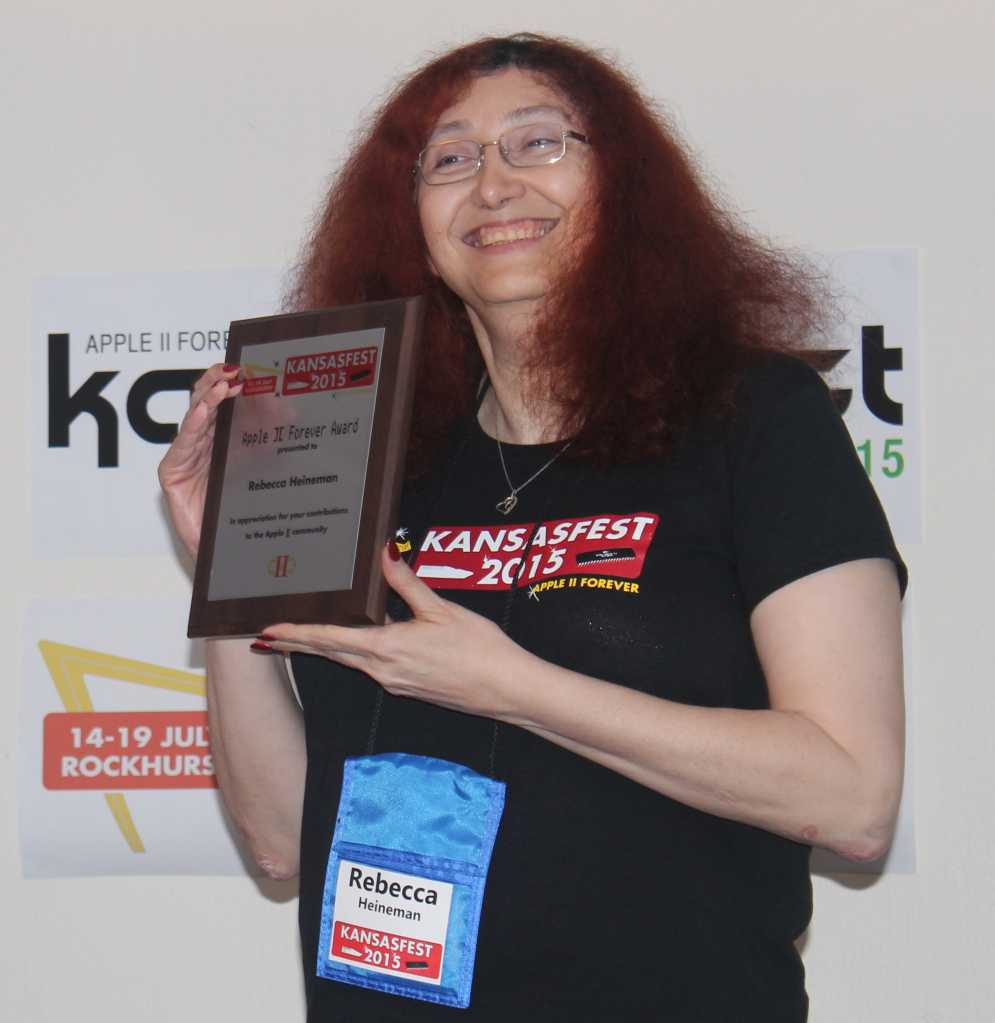
Rebecca Heineman
Ken Gagne
In 1980, a teenage Rebecca Heineman was crowned Space Invaders champion in the first-ever national video game tournament. Her star continued to rise from there: in 1983, Heineman was one of four co-founders of Interplay Entertainment, where she developed such games as The Bard’s Tale and Battle Chess. Later games from Interplay included Wasteland, Fallout, and Baldur’s Gate. Many of these franchises exist to this today, having inspired countless sequels, copycats, and television adaptations.
Heineman later founded Contraband Entertainment, MacPlay, Logicware, and Olde Sküül, and she was a trans advocate on Amazon’s LGBTQ+ group and with organizations such as GLAAD and Press XY. Through her memorable games, public advocacy, and “Burgertime” YouTube series, “Burger Becky” inspired countless developers, gamers, and members of the queer community. She was 62 when she died.

